
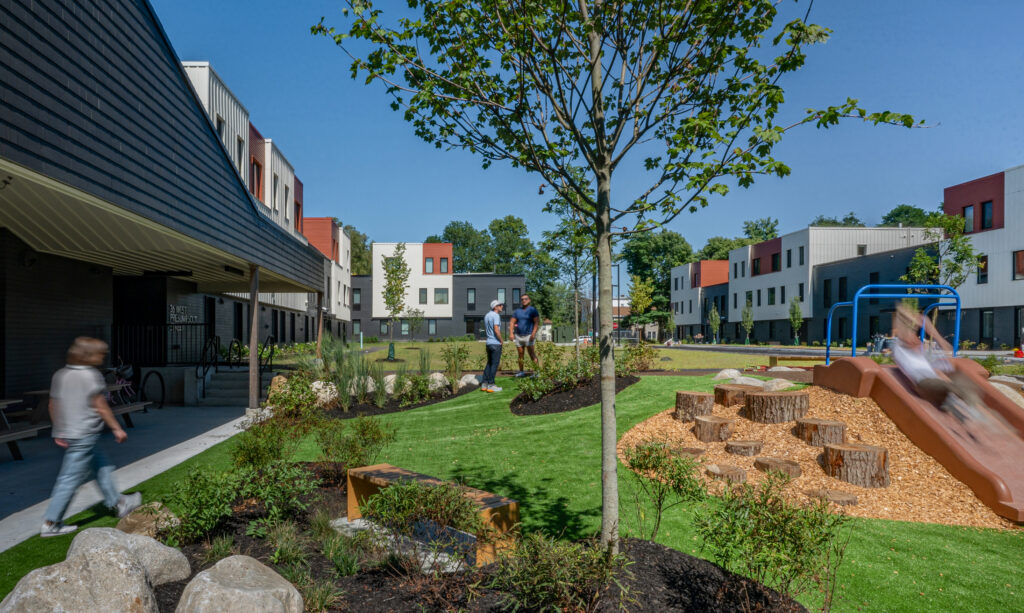
The Front Street redevelopment project in Portland, Maine, is a transformative effort by Portland Housing Authority (PHA) and Portland Housing Development Corporation (PHDC) to replace outdated housing with a modern, sustainable, and community-focused neighborhood. Originally built in 1971 as temporary housing, Front Street was constructed on a former city dump to accommodate families displaced during the city’s Urban Renewal era. However, over the decades, the prefabricated structures remained in continuous use despite their intended short lifespan. By the time redevelopment efforts began, the buildings were in poor condition and the site was classified as a brownfield, requiring significant environmental remediation.
Zachau Construction served as the construction manager, overseeing the multi-phase project that included five new low-rise residential buildings spread across two blocks in the desirable East Deering neighborhood, adjacent to Payson Park. The design, created by Utile, seamlessly integrates the new development into the surrounding community, featuring improved pedestrian connectivity and open spaces that enhance neighborhood cohesion. A central east-west pedestrian corridor links the two blocks, with a new community center and residential support spaces serving as key anchors.
A critical component of the redevelopment was ensuring that existing residents—many of whom had lived in the original units for years—could remain in their neighborhood. The new buildings prioritize family-oriented housing, offering a substantial number of three-, four-, and five-bedroom apartments. This is particularly significant given the scarcity of affordable housing in Portland that can accommodate large households, some with up to 10 members. The project not only preserved housing opportunities for these families but also expanded access to safe, modern, and energy-efficient living spaces.
Sustainability played a major role in the redevelopment. In addition to extensive environmental remediation efforts to clean up the brownfield site, all buildings were designed to meet Passive House standards, emphasizing energy efficiency, indoor air quality, and overall sustainability. These high-performance buildings feature continuous ventilation, minimal air infiltration, and well-insulated thermal envelopes, reducing heating energy consumption by approximately 80% compared to standard code-built structures. The design also enhances acoustic separation between units, improving residents’ quality of life.
Further demonstrating a commitment to sustainability, the buildings meet the U.S. Environmental Protection Agency’s Indoor Air Plus Program and the U.S. Department of Energy’s Zero Energy Ready Homes Program requirements, and Phase 2 includes a 45kW solar photovoltaic array that offsets the power needs of all common areas. The project also embodies Smart Growth principles, emphasizing walkability, close access to public transit, and unit density that maximizes the preservation of open space.
Through careful planning and thoughtful design, the Front Street redevelopment has transformed an aging, environmentally compromised site into a vibrant, modern neighborhood that supports Portland’s long-term affordable housing needs.
What successes and impact will this project have?
Providing 105 safe, affordable, sustainable homes for an underserved population of larger low-income families has tremendous social impact, both directly on the families housed and indirectly on the surrounding neighborhood and city. By blending in beautifully with the existing neighborhood, we believe the project design has helped reduce some of the social stigma that is often unfortunately associated with affordable housing. Walkability means families can live close to their place of employment, recreation, and education opportunities, and access services without the need for personal transportation, thus reducing associated transportation costs for families and reducing other environmental impacts, e.g., vehicle emissions, surface parking.
Front Street redevelopment was identified as a top priority in PHA’s 2015 Strategic Vision Plan. The plan considers how PHA’s properties, consisting of over 1000 units, can best preserve and strengthen the supply of quality affordable housing in Portland.
What challenges did you overcome in this project?
To complete the project, families living in the existing housing had to be relocated. Many were large families with up to 10 members. This was a significant undertaking by the Portland Housing Authority, and the successful relocation of those families demonstrates PHA’s commitment to their residents. The residents were provided with professional movers and supplies to help them get to their new homes. PHA’s full time Relocation Coordinator also worked with the public schools to make the transition as smooth as possible for younger residents. All 43 families were offered a new unit at Front Street; 13 families accepted that offer. Current tenants have a Resident Services Coordinator that helps them connect with local services as well as a Community Center on site for use by residents.
In addition, before the buildings could be renovated, the entire site required Brownfield remediation. City, State and Federal funding were all required to assist in paying for the cleanup, and PHA still had to make a large investment of their scarce resources to ensure a healthy environment. The site also required extensive ground improvements utilizing rammed aggregate piers to adequately support the new structures.
The project also was bid and awarded in the height of the Covid pandemic and started construction in 2021 with challenging supply chain issues and labor shortages.